Showing posts with label Climate change. Show all posts

Saturday, 17 November 2018

Climate Change and the Rise of the Extreme Right


The title indicates, for me, the two major issues facing humanity in the next 50 years. They are not unrelated. Climate change has finally gained the attention of the general public and they demand action from their elected governments. Unfortunately, the political world is not in a position to take decisive action and this for many reasons, the principal one being that governments themselves are generally hogtied by the economic interests of multinational corporations who prefer to focus on the struggle for larger profits for their masters. In this sense, governments like the United States and Canada, to name the two closest to home, are fundamentally fascist, if by fascist one means an authoritarian government whose policies are dictated by a small group of business interests. Such governments present themselves in a language that appeals to the well-being of low-income workers. They offer programs to assist those suffering setbacks in the economic system. However, we would be mistaken to take the measures as a serious preoccupation with the well-being of the population  as a whole since the purpose of this political rhetoric is to pacify those sectors of the population that might tend to revolt against the conditions of life imposed on them: long hours, poor conditions, inadequate pay. 
 
So, in fact, we have governments that are deeply rooted in far-right philosophies of authoritarianism and the supremacy of the economy. They encourage, as the primary virtue of the citizen, the right to consume! Citizens are taken seriously as such to the extent that they consume. The Extreme Right is made up of groups who believe they are benefiting from this sort of authoritarian government without realizing that, since their members come from the less-economically benefited sectors of society, they are in fact victims of a fascist system. (Lower ranks of the military are also very present in this category.) Large corporations and government are satisfied to see the presence of such Extreme Right groups since they serve to divide ordinary citizens and weaken a grassroots opposition. They are “useful.” 

All of this plays out very well for the interests of the multinational economic interests in delaying an effective response to climate change. These interests know very well that climate change will deeply affect the capacity of humanity to survive on the planet. However, they leave that for another generation to deal with, confident that the people of their category will have ample resources to assure the survival of their 0.1 percent of the population (around 80 million people). These will be sufficient to guarantee a vibrant economy since the rest of the population are, in any case, “excess,” that is to say non-consumers.

This is not a happy picture I am painting and I do so to point out that we put our trust governments at our own peril. Obviously, it is better to have a government that listens seriously to its electors. But the solutions will not come from them since they are beholden to the grand masters of the current economy. Even though the Extreme-Right is a tiny minority, their role as a dividing force within the ranks of the general population is important and will grow to the extent that large sectors of the population are subjected to ever more precarious conditions. This tiny minority needs to be taken seriously since they voice the anger and frustration of a much larger section of the population which are directed to turn their anger against the most vulnerable minorities rather than the economic and political decision-makers.  Somehow or other the larger population needs to have a change of mind and heart that will lead to a greater cohesion and solidarity in facing the issues and in shaping grassroots movements for survival. It is extremely encouraging to see the multiplication of citizen-based movements throughout the world who are advancing powerfully and effectively to face the challenges of climate change.

Friday, 31 March 2017

The Right to be Cold

Every year the CBC holds a week-long radio debate on five books selected as the most significant published in Canada during the previous year. This year one of the finalists was The Right to Be Cold by Sheila  Watt-Sloutier. It was eliminated in the third round. What is interesting is the argument presented by the debater who broke the tie to eliminate it: “My mom says it has too much information.”
It is a book that presents itself as a memoir of an Inuit women who grew to become an international spokesperson for the Inuit peoples of the polar region (five countries where the Inuit live, including Canada, Alaska, Greenland and Russia).
What lies behind “mom’s” comment is, I believe, an inability to move beyond the concept of a singular individual presenting a memoir to the collective memoir of a people. It is a specific inability of our modern Western culture that is becoming more and more evident – and pathological.

While the idea of the individual as an important centre of attention, came into its own through the time of the Enlightenment in Europe, the earlier period in Europe as also among Indigenous peoples throughout human history has been much more collective. The inability of many at this time to place themselves in this latter framework is one of the important reasons why we are increasingly unable to deal with global issues. 

Monday, 11 January 2016

Journal #1: State of the Planet

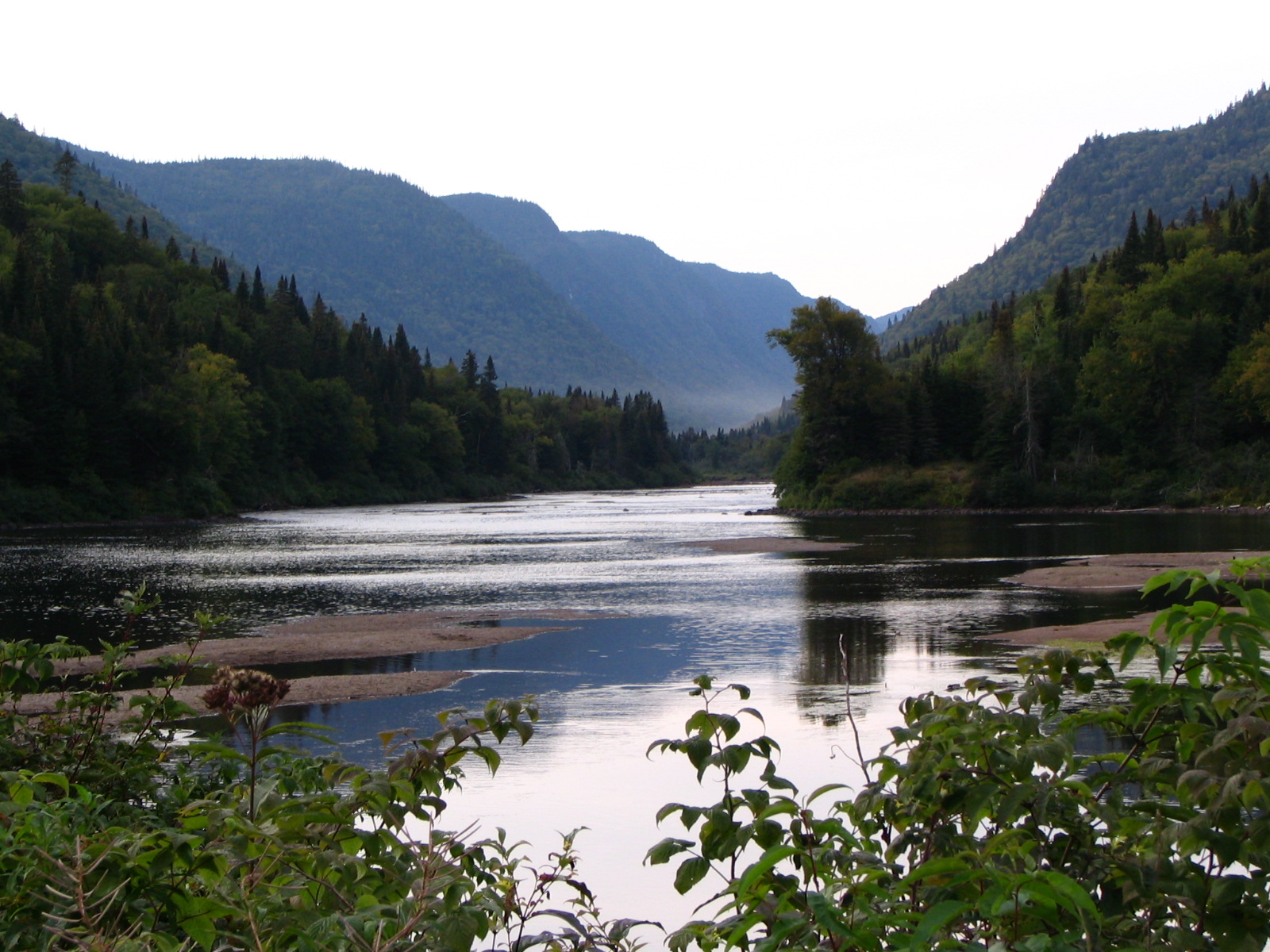
Quebec lake
Over the years I have done a lot of writing. Too much perhaps. Anyway, in the early 1990s I took a program called "Global Transformation Studies" at OISE (Toronto). One course required a journal. Over the next weeks, I will post a few excerpts from there. Here is the first:

My initial reaction to rereading the "state of the planet" is one of disbelief. It can't really be all that bad. After all, twenty years ago, the scientists were telling us that the worlds" resources would be exhausted by the end of the century. (Dennis Pirages and Paul Ehrlick, Ark II,W.H. Freeman & Co, 1974). et we seem to be going on with "business as usual." Then I listen to a CBC news report a couple of days ago: the last virgin forest in North America is opened to logging, the entire fishing industry of Newsfoundland (Newfoundland!!) has to be dimantled, there is a hold over Antarctica as big as the U.S.A. All in one news report.
The planet may be able to regenerate from our destructiveness - though there is no assurance of that. The critical issue for us as humans, is that we may not survive the process! When I read about how the CFC's operate in the stratosphere, it is frightening. We don't really know what we have unleashed!
...
Can we let go of the addiction to privilege? Can the Third World free itself from the encroaching enslavement to the same dream? Can we return to an earlier vision of our place in the scheme of things? - which is never really just a return but a reinventing of the old in an entirely new and transformed setting.   (to be continued...)

Thursday, 18 June 2015

Pope Francis on Climate Change


https://robertscribbler.wordpress.com

My comment is not intended to explain the encyclical nor to provide a summary. I just want to encourage you to read it carefully. It comes in at less than 200 small pages. It can easily be read in one day, two half days or an hour a day for a week. There is nothing in it that anyone who is familiar with ecology, especially eco-theology, will find especially new. What is new is that this is a very official Church document and thus it presents a framework for the work of the Church in the next decades.
There is a precedent. In 1963, Pope John XXIII, after convening the Second Vatican Council, published an encyclical called Pacem in terris. In this encyclical, and for the first time in history, the Church addressed the question of human rights in positive terms and laid out an argument for world governance through international law. This encyclical, Laudate sii – the opening words of St. Francis’ Canticle of the Sun, does something similar for the care of the earth. It is about climate change and it takes a very strong position. However, it is much more than that, it situates human beings in relation to the earth and elaborates for the first time the ethical, spiritual and theological principles that guide us in that relationship.
As the Pope himself insists, this is not a scientific document though it draws extensively on what scientists are saying about climate, ecological systems and the impact of humans on the earth as well as the way in which humans relate to one another especially in an urban setting. Ultimately, it is a document about moral guidelines for living into the future that are deeply rooted in our biblical tradition as Christians. In this respect it is a fundamental document not just for Catholics but for anyone who follows a belief tradition.
In the text you will find a strong call for not only ecumenical action (with reference to Patriarch Bartholomew) but also to interreligious solidarity (with a reference to the Sufi tradition).
In general, my impression is that the text was carefully crafted to take into account the basic framework of contemporary ecological studies and eco-theological studies. There is only one glaring flaw: no mention of women. It seems to me that the contribution of women to the development of cosmic consciousness, ecological sensitivity and eco-theology has been impressive. Surely there could have been some place at least to acknowledge that. Here is another case of the Church’s inability to integrate one half of humanity into its theological and spiritual framework.
That aside, it is a ground-breaking document in several respects and stands as a dramatic call to action for decision-makers all over the world. That includes each of us, every day.  

Sunday, 12 May 2013

The Scenario


The plan is actually quite simple. By now, everyone knows that climate change will make much of the world uninhabitable. Huge storms will cause catastrophes including loss of infrastructure, migration and massive deaths. Food will become scare -- over half of the arable land on the planet has already been destroyed.
The richest of the planet, the one percent, have a plan. It is probably not a conspiracy but rather a shared implicit logic that grows out of preserving self-interest.  More and more the lines of that logic are becoming clear.
Massive amounts of money are poured into arms and the military needed in order to control the unrest and wars that erupt as a result of changing conditions.
Because of the disruption of climate change as well as the wars that result, close to 90% of the world’s population will disappear. (Many scientists agree on this percentage.) That will leave just enough people to assure the infrastructure (food, industry, security) that would allow the very rich to continue in their lifestyle. In fact the 90% who will disappear are, in any case, dispensable within the current economic structures.
Massive restrictions on freedom and powerful military deployment will be needed to make sure that the  population remains faithful to their job of producing enough to keeping the workers in the economy alive and satisfied as well as, especially, to maintain the lifestyle of the very rich.
Should the planet swing entirely out of control, a last-ditch emergency plan would be to set up on another planet. The proposed one-way expedition to Mars is a trial balloon in that direction, an avant-guard who will work out the details of establishing a human colony elsewhere. Ultimately this would, once again, imply the transfer of a very small group (0.1% of the 10 % that remain, along with enough people to work to keep them in comfort). In a sense, society will continue to be normal in the sense that there will be approximately the same propositions of super-rich, middle class and poor. In that sense, everyone will continue to find their place though the scale will be reduced.  Those who retire into self-sufficiency, who provide for their own food sustainably will be inundated with hungry outsiders or raided by armed looters.
Am I exaggerating?  Am I retreating into science fiction? Not entirely. This is a scenario that could be realized within the next fifty years, that is to say, within the lifetime of many of those already living on the planet. What is needed is a massive, global upheaval. I am pretty sure that, at some point, it will come. However, I am also sure that the super-rich will be ready with their (massive) security precautions in place.
There is of course an alternative, a difficult one but one that is quite realizable. As long as we continue to contribute to the destruction of the planet required by the growing inequality between the super-rich and those entirely abandoned by the world economy, the logic described above will surely work its way forward. Fiddling with the current economic and political structures have repeatedly demonstrated little or no changes in the patterns.  Why is it that most people in the world, who are very aware of the general lines of this process, continue to follow their daily routines. We accept the political and economic processes with resignation and believe that the imperfections will be dealt with by those who hold public office?  What could be more insane?

Tuesday, 1 January 2013

The Great Plague of the 21st Century

I warn you that the following is not a glowing report of hopes for the future grounded in New Year optimism. It is, in fact, rather apocalyptic.. In any case, what I say here needs to be said and even repeated.


Found at http://hoocher.com/Charles_II
_of_England/Charles_II_of_England.htm
    A strong link exists, it seems to me, between the growing inequality in the economic world (where relatively few individuals now control the majority of the world’s economy) and the obvious crisis for humanity represented by the rapidly advancing phenomenon of climate change.  At the same time, it is important to underline from the start that climate change does not represent a crisis for the planet. Earth is quite capable of dealing with the impact of the various devastations posed by human economic and military adventures. It will adapt and continue to foster life. More than that, Earth will deal with the impact of human presence as it does with any other extreme phenomenon by eliminating the cause. It is humans who are in crisis of extermination. Moreover, I am convinced that the wealthy and powerful of this world are, consciously or subconsciously, aware of this and have, for a long time now, been taking measures to deal with it in their own way.      This tiny but privileged group is aware that the current economic and political trends are suicidal and so, true to their nature as controllers and dominators, have determined to make sure that they, at least -- if no others -- will survive. They have confidence that their immense economic and political leverage will assure that, when push comes to shove and when the economic, geophysical and political structures fall into chaos, they will be able to provide a “bubble” to protect themselves. Even under the direst scientific predictions, about 10% of the population should be able to survive. They want to make sure that they are included. Theirs is a huge gamble but, as a group they are the ultimate gamblers.
     This tiny group of hugely influential individuals believe in their privileged capacity to surround themselves with the security provided by gated communities, military and paramilitary protection as well as all the infrastructures to assure that they need not worry about anything that happens to the planet. While I do not believe there is an overt conspiracy here, I do believe that their reliance on the power to control leads them inevitably toward a logic that leads to a conviction that power over economic and political process is the path to ultimate security. There is also a corollary: To hell with the rest of the world!  What is worse, I also think there is a chance that may be right.
     There is still another layer to this: Much of the world, especially the Western world, believes this also and, even though they are excluded from the securities provided to the rich and powerful, they are convinced that, given the right circumstances, they will be able to assure their place inside the bubble. Instinctively they realise that those few super-rich individuals will need people around them who sustain and support their survival. They want to be part of that bubble when it arrives. For this reason, most of the population of North America and Europe is ready to “go along with the system” and hope that the bubble will be large enough to cover them. As a result, the political and economic process continues regardless of its obvious consequences for vast regions of the world. The greatest danger to the survival of humanity lies with this internalized subjugation within the minds of the vast majority of the population. Moreover, the educational and media industries reinforce this internalized mentality day after day.
     The picture painted here is quite sombre and could easily lead to despair about the future and our ability to shape it for the good of all. We are in a time when faith and hope are faced with a darkness unlike anything society has known in past centuries -- except perhaps in Europe during the time of the Great Plague.
    In fact the experience of the Great Plague in Europe is worth exploring. At that time people experienced a terrible devastation that took tens of millions of lives without understanding where it was coming from or why. It took decades of persistent investigation to pinpoint the source of the problem, then more decades to convince society to deal with it. In the meantime the devastation continued. What is hopeful in all this is that eventually reason prevailed and, while it was the poor who suffered the brunt of the disaster, eventually the process wore itself out and people began to organize to protect society as a whole from the menace. There is a difference however, the plague was an epidemic. Epidemics have a life, it would seem, of about twenty years. By then the immune has adapted, to a large extent, to resist the attack. Unfortunately, in our current situation, there does not appear to be any immune adaptation foreseeable.
    If the worst scenario is to be avoided, it won’t happen without considerable effort and enormous losses along the way. We have an option before us: confide in the richest and most powerful to protect us, or dislodge the destructive trend -- against all odds, with a faith and courage that is not diminished by the enormity of the odds.

Sunday, 21 October 2012

Climate Change - We CAN Make a Difference!


   Today it is, I think, safe to say that no one doubts that the process of climate change now underway is the greatest challenge since tens of thousands of years to the planet, and more precisely to humanity.  However, perhaps like you, I have often felt that the little adaptations we try to make to our lifestyle are really a drop in the bucket compared to the need for massive transformation of our entire economic and industrial machine. In face of the urgency to stop the use of fossil fuels in industry, the military and transportation systems, it seemed futile to hope that turning off my computer when not in use, or lowing the temperature in the house a couple of degrees would make much difference. And while it is true that the cumulative effect of all these efforts can be quite monumental, it is certainly not enough. Governments have to step in and regulate.
   And my frustration grew when major international gatherings like Rio, Kyoto, Copenhagen, Durban and Rio+20 seem, at least according to press accounts, resulted in no significant agreement.   In face of this urgent need I feel vulnerable and impotent -- also angry!
   Thus my surprise to discover Jean Desrocher’s interesting book, The Challenge of Climate Change, published by the Center for Social Justice in Bangalore, India (2012). John is the founder of the centre and its guiding light. He has published numerous serious studies over the last 20 or 30 years and has acted, for some time now, as a consultant to the Catholic Bishops Conference of India on issues relating to social justice. John’s forte is the summary of an extraordinarily broad array of relevant documents, carefully laid out and analyzed in order to provide a thorough review of the issues and options involved in whatever study he undertakes.

   For me there are two important discoveries in this book.  The first, and it is very important, is that all the efforts of the last 20 years have not been in vain. Enormous progress has been made and enormous changes have taken place, not only in the awareness of billions of people across the world, but also in government and business. The growth of a “green consciousness” with all sorts of inventive initiatives to explore alternatives has advanced by leaps and bounds. We are in a much better position to make the transition to clean energy than we were a couple of decades ago. There are hold-outs of course and they stand out remarkable. But, they are also more and more encircled by a wave of pressure for change.
   The second issue that came to the fore for me, and that I had not paid enough attention to in the past, is that there has been an enormous growth in the organization of the countries of the Global South to provide a clear path to the transformation required in a way that would be both feasible and fair. It has not been easy and there are still splits among the various countries. But a broad path has become clear. The countries of the Global South realize that the greatest impact of climate change will fall on their peoples. Moreover, they also realize that they do not have the means to make the transition without help from the industrialized world. They also believe strongly that their peoples should not be expected to set aside their aspirations to rise out of poverty but that the industrialized world that has been at the origin of the crisis over the past 100 or even 200 years, should take responsibility for what they have done. Thus they demand of the industrialized world that it cut back on its production of greenhouse gases and, at the same time, help the countries of the Global South to learn the new technologies and have the resources to support the transition even as they develop the productive structures that will allow their people to eliminate poverty.

   They have, in making various proposals over the years, found themselves facing a solid wall of resistance particularly from countries like the USA, China and Australia who demand that everyone make an “equal effort” -- even though the responsibility for causing the crisis and the means to deal with it are not at all equal!
   What has particularly surprising for me is that the economic burden for dealing effectively with climate change over the next 30-40 years is not, actually, all that great. It requires a program that would, in some ways, represent a global “Marshal Plan” and that could cost trillions of dollars each year. However, in the global context, given the global economy, given the current priorities, particularly military, a few trillion set aside each year by a consortium of all the industrialized nations would not necessarily have a major negative impact on the general standard of living of people in industrialised nations and would allow for a rise in the standard of living of people in the Global South. It is this realization that the fight against global change is not a herculean one, that is can be reasonably budgeted for and carried forward within the parameters of the current global economic process that leads to hope.
 
   In other words, the hitch is not technological, is not economic.  It is political and we can name the actors and then begin to mobilize around that. The actors are the industrialized nations, particularly the USA (with Canada), China, Australia and a few others. The political change that has to happen is one of moving the political culture out of the stance of self-interest for one’s own limited bailiwick (nation, region) and a move toward a governance that looks to the common good of all. There was some indication of this sort of politics after the Second World War with the establishment of the United Nations and all its satellite programs. It can be done, if…  if people will just mobilize on a grand scale to demand it of their leaders. And what is marvellous is that, today, we have precisely the means to mobilize those hundreds of millions of people through contemporary means of communication. Here I am not talking about the major media. They are clearly in the hands of those who have very narrow economic self-interest. Rather, I refer to that massive channel of alternative means of communication that have already mobilized people around the world on a vast array of issues. There needs to be a massive, unmistakable, unavoidable public outcry from hundreds of millions of people in every part of the world. When that happens, over and over again, politicians tend to get the message. They don’t like it. But, history moves forward. It is really up to us.